
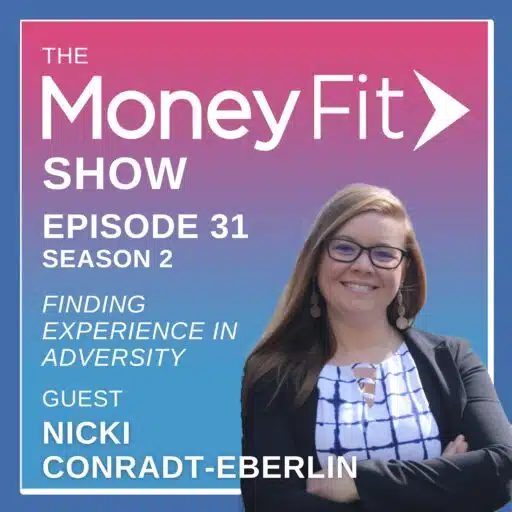
The Money Fit Show · Season 2, Episode 31
Finding Experience in Adversity
Nicki Conradt-Eberlin became financially self-sufficient while she was still in high school. She joins Todd Christensen to discuss working as a teenager, paying household expenses, saving for a car, using credit carefully, dealing with student loans, changing careers, and learning to view difficult experiences as information she could use later.
Turning difficult experience into useful experience
Play Season 2, Episode 31 directly through Spotify without leaving Money Fit.
Responsibility arrived early, but so did financial experience
Nicki describes becoming largely self-sufficient at 16 because of difficult circumstances at home. While still attending high school, she worked, bought groceries, paid for insurance and a phone, and saved several thousand dollars toward her first vehicle.
Her first job was inside an in-school credit union branch. After graduation, she continued working in the credit union industry while attending community college and later completing two bachelor's degrees.
Looking back, Nicki describes experiences she would not have chosen but says they gave her practical knowledge, independence, and confidence. That perspective later became part of her work helping other people identify goals and build habits around them.
Topics covered in this episode
- Becoming financially self-sufficient while still in high school because alcoholism and instability within the family required Nicki to take on adult responsibilities early.
- Working her first job through an in-school credit union branch and gaining early exposure to financial services.
- Saving approximately $3,000 to $5,000 toward her first vehicle at age 16 while also paying for groceries, insurance, a phone, and other expenses.
- Using her interest in horseback riding as motivation to continue working, saving, and building enough financial stability to support something she cared about.
- Moving into full-time credit union work after high school while attending community college and eventually earning two bachelor's degrees.
- Using a low-limit credit card during and after college and keeping borrowing within boundaries she felt able to manage.
- Facing uncertainty after graduation and recognizing that completing an education does not automatically make the next career step obvious.
- Looking more closely at student loan balances after college and recognizing how interest and time can affect the total cost of repayment.
- Learning about financial products through online research while also relying on mentors, professional experience, and educational materials available through employers.
- Realizing that she especially enjoyed training and onboarding other people and using that insight as part of her eventual move toward coaching.
- Nicki's personal-development framework of moving away from a scarcity mentality and becoming more willing to pursue opportunities while building her business.
- Recognizing that different clients may define success differently and that useful goals need to reflect the individual rather than a single standard.
- Looking back with gratitude on experiences that were difficult at the time because of the skills and perspective she believes they later helped her develop.
- Reframing difficult periods by asking what was learned, what changed, and what can be handled differently the next time a similar challenge appears.
- Checking in with your finances consistently so you know where money is going, how spending is changing, and whether current choices still match your priorities.
Check your money often enough that problems stay small
A financial check-in does not need to become a major budgeting session. Review account balances, upcoming bills, recent spending, debt balances, and savings regularly enough to notice changes. A problem that takes five minutes to correct today can become much harder to handle after several months of avoiding it.
Build visibility around your money
Nicki's story emphasizes regular financial awareness, manageable use of credit, planning for debt, and connecting day-to-day money decisions with longer-term goals.
Nicki Conradt-Eberlin
Nicki Conradt-Eberlin joined Todd Christensen as a life coach and founder of Unleashed Leadership.
Her background included credit union work, higher education, training, onboarding, horseback riding, and experiences becoming financially self-sufficient at a young age. At the time of this episode, her coaching focused on helping clients identify goals and develop habits involving discipline, consistency, focus, and accountability.
Her discussion with Todd combines practical financial experiences with personal-development ideas about scarcity, opportunity, gratitude, and reframing adversity. Those coaching concepts reflect Nicki's perspective and are not presented as substitutes for addressing the practical financial conditions someone may be facing.